Car Valuation for a Debt Relief Order: the £4,000 Limit
For a debt relief order (DRO) in England and Wales, your car must be worth less than £4,000 "if you were to sell it today" to be kept out of your assets. The Insolvency Service tells debt advisers that Parkers gives acceptable free valuations for most registered cars, and that if Parkers has no figure they can accept two valuations from independent and reputable sources.
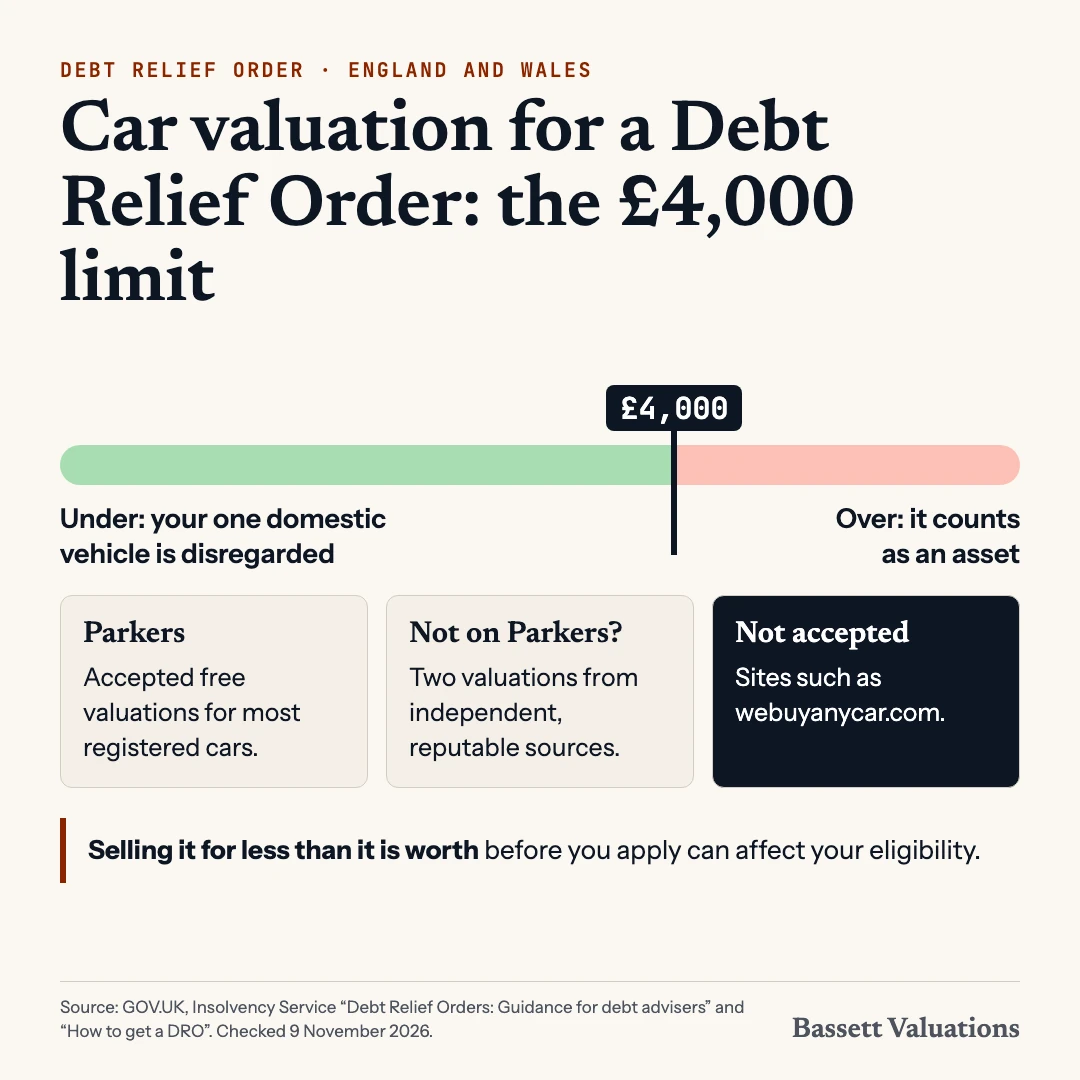
This guide covers what the £4,000 limit means, how the figure is found, and what to do when your vehicle is one the price guides cannot see. Your debt adviser, the approved intermediary, makes the assessment and the application; a valuation is evidence for them, not a decision.
Car not on Parkers? Ask us for an independent written value.
Your price is confirmed in writing before any work begins.
What is the £4,000 vehicle limit in a debt relief order?
It is the value up to which one domestic vehicle can be left out of your assets. GOV.UK lists the eligibility rules for a DRO: you owe less than £50,000 in total, have savings or valuable items worth less than £2,000 in total, and "own a vehicle worth less than £4,000 (if you were to sell it today)".
| Situation | How the Insolvency Service guidance treats it |
|---|---|
| One domestic vehicle under £4,000 | Disregarded when the adviser adds up your assets |
| A second vehicle | Can be kept under the £2,000 asset limit, with its costs checked |
| Vehicle adapted for a disabled person | The £4,000 limit does not apply; it is still declared |
| Company vehicle you only use | Does not count towards the asset limit |
The guidance for advisers is the Insolvency Service's Debt Relief Orders guidance, updated on 9 March 2026; the rules for applicants are on GOV.UK, How to get a DRO.
How does a debt adviser value a car for a DRO?
With a recognised source, not a quick online offer. The adviser guidance says: "Parkers provide acceptable free valuations for most registered cars." If Parkers has no valuation, "an approved intermediary can accept two valuations from independent and reputable sources." It adds: "We do not accept sites such as webuyanycar.com for realistic valuations for vehicles." For motorbikes, the official receiver accepts valuations from reputable organisations such as The Bike Market.
An instant buying offer is a trade price, built to resell at a profit, so it is not what the car would fetch in a normal sale. Our guide to why car valuations look so low explains the different prices you see online.
Imported, classic, converted or rare, and Parkers has nothing? Send us the make, model, year and mileage and we tell you if we can value it.
Check if you can value my carFree price first. No obligation.
What if Parkers has no figure for your vehicle?
Then the adviser needs two valuations from independent, reputable sources. That is common with an imported car, a camper conversion, a classic, an unusual specification or a vehicle that has been modified. For "unusual or specialist items", the guidance says they "should have these valued by a specialist agent".
A written valuation report shows the vehicle, the market evidence used and how the figure was reached, so an adviser can see where the number comes from. You can see the layout on our sample vehicle valuation report. Whether it is accepted, and whether a second valuation is needed, is for your adviser and the official receiver to decide.
What if the car is on finance or a logbook loan?
The value still matters. The guidance says repayments on a vehicle under hire purchase are an allowable expense if the vehicle would be exempt, for example "the value of the vehicle at the date of the application was less than £4,000". For a vehicle over £4,000 on HP, payments are not allowable unless they are needed for basic domestic need. If a logbook loan ends during the DRO and ownership goes back to you, "the DRO may be revoked if the value of the vehicle is greater than £4,000".
Can you sell the car before applying to get under the limit?
Not for less than it is worth. GOV.UK says: "You must not give away or sell any valuable items for less than they're worth." The adviser checks whether you have "sold or given away any valuable items" in the last 2 years, and those undervalue transactions can affect your eligibility. During the DRO, a vehicle you receive has to be reported to the Insolvency Service. A valuation dated close to the sale is one way to show what the car was really worth.
Frequently asked questions
Can I keep my car with a debt relief order?
Yes, if it is your domestic vehicle and it is worth less than £4,000 if you were to sell it today. The Insolvency Service guidance lets the adviser disregard one domestic vehicle up to that value. A vehicle adapted for a disabled person is not subject to the £4,000 limit.
How is a car valued for a DRO?
The Insolvency Service guidance for debt advisers says Parkers provides acceptable free valuations for most registered cars. If Parkers has no valuation, the adviser can accept two valuations from independent and reputable sources. It does not accept sites such as webuyanycar.com.
What if my car is worth more than £4,000?
It counts as an asset, and the total assets limit for a DRO is less than £2,000, so you may not qualify. Your debt adviser decides how your case is treated. Do not sell or give the car away for less than it is worth to get under the limit: undervalue transactions can affect eligibility.
A value your adviser can follow
Tell us the make, model, year, mileage and that it is for a debt relief order. We send a written price first; once confirmed, your report usually arrives the same working day.
Get my written valuationFree price first. No obligation.
Sources: GOV.UK, How to get a Debt Relief Order (DRO) and Insolvency Service, Debt Relief Orders: Guidance for debt advisers, read on 9 November 2026.