V55/5 Form: What It Is, Who Needs It and Where to Get It
The V55/5 is the DVLA's form for first vehicle tax and registration of a used motor vehicle. You use it for a used import, a rebuilt vehicle, an older vehicle that has never been registered, or a vehicle brought back to the UK after being exported, and you download it from GOV.UK.
A new vehicle uses form V55/4 instead. On paper the V55/5 is two pages. In practice each vehicle changes which boxes apply, which certificate the answers come from and which papers must travel with the form. So this guide shows the real form: the boxes that trip people up, what goes in each, and where the DVLA says applications fail. It follows GOV.UK's October 2025 guide to filling in the V55/5 (called V355/5).
In short, the V55/5 is what asks the DVLA to put the vehicle on the register and send you the V5C registration certificate. It is one of the last steps. GOV.UK has you make the import declaration and pay any VAT and duty first, then tell HMRC through NOVA, and only then send the V55/5, so a mistake in it holds up the whole import.
Want your V55/5 ready to sign and post? We prepare it and check it against what the DVLA asks for.
Which form do you need?
Start with your vehicle. GOV.UK's registration page and the V55/5 page sort the cases like this:
A used import
Or a vehicle brought back to the UK after being exported.
Older or rebuilt
An older vehicle the DVLA has never registered, or a rebuilt one.
A new vehicle
Including a new import and a newly built kit car.
A used UK car
No new application: the seller registers it to you. No V5C? GOV.UK points you to form V62.
Source: GOV.UK, vehicle registration and the V55/5 page. Read on 6 November 2026. A kit-built vehicle follows the new-vehicle route and needs extra papers, such as form V627/1: read the kit-built section of the registration page before you start.
What is the V55/5 form?
Its full name is "Application for first vehicle tax and registration of a used motor vehicle". It has two pages. Page 1 holds the vehicle details, in numbered boxes 1 to 68. Page 2 holds the list price, your name and address, your date of birth, the mileage and the declaration you sign, in boxes 69 to 76. A car or light van skips boxes 74 to 76, which are only for vehicles over 3,500kg.
The DVLA puts what you write on its records, so the details must be accurate. The form itself is the easy part: the work is matching every answer to the right document for that particular vehicle. The V55/5 even warns on its first page that incomplete forms will be rejected.
Where do you get the V55/5 form?
From GOV.UK, on the page Register a used vehicle for the first time (V55/5). It offers the form as a PDF, with the guide to filling it in beside it. GOV.UK last updated that page on 20 October 2025, and the guide carries the date code 10/25. A Welsh-language version, V55/5W, is on the same page. Print it and write clearly in black ink in capital letters: the DVLA says a form that is hard to read takes longer to turn into a V5C.
A tour of the boxes that trip people up
The form looks like a wall of boxes. Most mistakes come from a handful of them. These are crops of the DVLA's own blank form; the orange circles match the numbered notes under each picture.
1. The top of page 1

- Box 1, registration number: leave it empty. The DVLA fills it in.
- State country vehicle purchased from: write the country here. The guide asks for it on every import.
- LHD or RHD: tick left-hand or right-hand drive. The guide asks for this on every import too.
2. Copy, do not guess
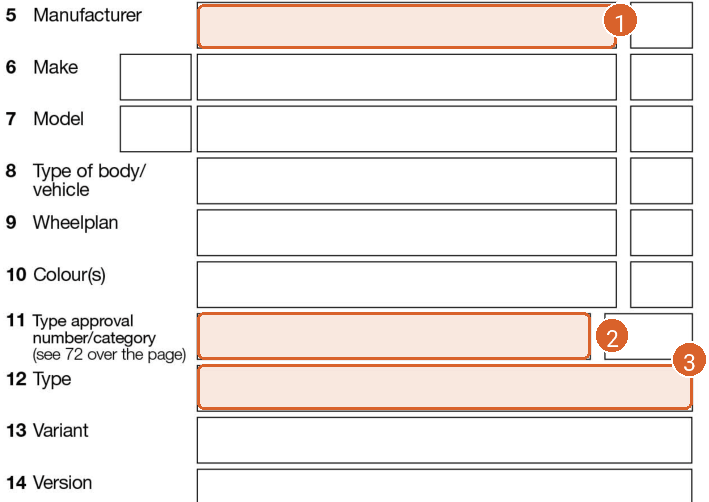
- Box 5, manufacturer: the guide says to take it from the Certificate of Conformity, or the IVA or GB conversion certificate.
- Box 11, type approval number or category: from the Certificate of Conformity. If the vehicle needs no type approval because of how it was built, leave it blank and answer box 72 on page 2.
- Box 12, type: from the Certificate of Conformity, or the IVA or GB conversion certificate. Copy these three letter for letter.
3. What comes off the vehicle, and the dates
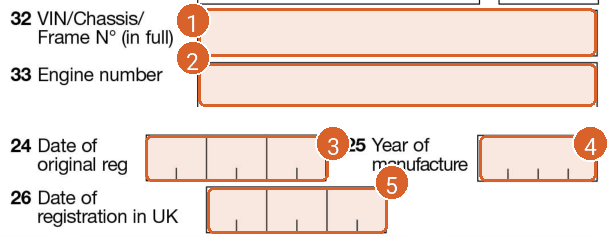
- Box 32: the full VIN, chassis or frame number, as stamped into the vehicle.
- Box 33: the full engine number, taken from the vehicle.
- Box 24, date of original registration: the date it was first registered, in any country.
- Box 25, year of manufacture: the year it was built, for example 2001.
- Box 26, date of registration in UK: the date it was first registered in the UK.
Not sure which document each box comes from? One wrong answer or one missing paper can send the application back, and then the wait starts again. We prepare your DVLA registration pack and check it against what the DVLA asks for. The DVLA makes the decision, and you send the pack in.
Don't risk a returned form: let us check your packFree price first. No obligation.
4. The price that can sink a newer car

- Box 69, list price or notional price: required for M1 type-approved vehicles. An M1, M1G or M1SP vehicle registered on or after 1 April 2017 is rejected without it. It is the price on the day before the vehicle will be taxed and registered. The grey strip below is for DVLA official use only.
5. Miles, not kilometres

- Box 72, exempt from type approval? If yes, give the full reason. The guide's example is an enduro bike.
- Box 73, mileage: the figure on the speedometer when the vehicle is registered, in miles. The form prints "Miles (not kilometres)" next to the box.
6. The line everyone must sign
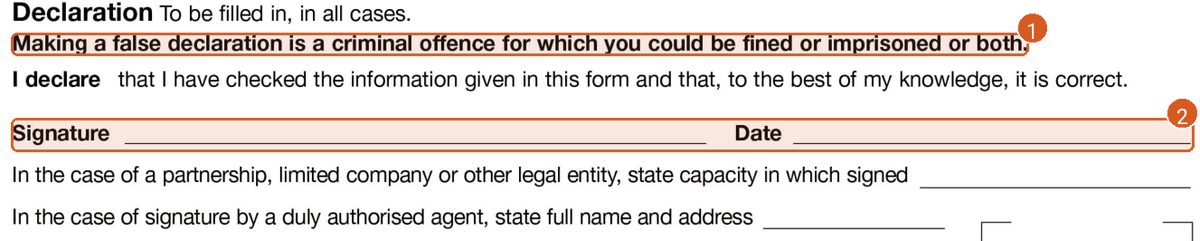
- The warning: the form itself says making a false declaration is a criminal offence for which you could be fined or imprisoned.
- Signature and date: sign and date it. The DVLA says it will not accept an application that is unsigned.
Where do the answers come from?
If you prefer a list, here is where the guide says each answer comes from:
| What it asks | Where the guide says to take it from |
|---|---|
| Manufacturer, type approval number, type (boxes 5, 11, 12) | The Certificate of Conformity, or the IVA or GB conversion certificate |
| Wheelbase, cylinder capacity, CO2, emissions and most other technical boxes | The Certificate of Conformity; for many boxes you may leave them blank if you send an IVA or GB conversion certificate |
| VIN, chassis or frame number, engine number (boxes 32, 33) | The vehicle itself |
| Dates and year of manufacture (boxes 24 to 26) | You: the first registration counts in any country, the UK one is separate |
| Mileage (box 73) | The speedometer, in miles |
| List or notional price (box 69) | Only for M1 type-approved vehicles |
| Name, address, date of birth, contact details (boxes 70, 71) | You. The date of birth must be given if a person is the keeper, and it does not appear on the V5C |
Source: GOV.UK, V355/5 guide to filling in the V55/5 form, October 2025 edition. Read on 6 November 2026.
Box 3 asks whether you want 6 or 12 months of vehicle tax, and box 4 is the first registration fee. An import has three extra jobs: write the country you bought the vehicle from in the top right-hand box, tick left-hand or right-hand drive, and enclose the original non-UK registration document or certificate, which the DVLA does not return. If you have no original, send a letter of explanation with a dating certificate from the manufacturer or another acceptable source.
What gets a V55/5 rejected or slowed down?
The guide names these:
- No signature, or a form not filled in properly. The DVLA says it will not accept the application.
- No list price on a newer vehicle. For M1, M1G and M1SP type-approved vehicles registered on or after 1 April 2017, the list or notional price must be given or the application is rejected.
- The wrong identity papers. Send a photocopy of a UK photocard driving licence, or photocopies of one document proving your name and one proving your address. Do not send originals. Without the documents it asks for, the DVLA will not accept the application.
- HMRC not told. An imported vehicle must be notified to HMRC within 14 days of arriving, and you need HMRC's written confirmation before you can register and tax it.
- A seriously damaged import. The DVLA cannot register or tax an import classed as seriously damaged abroad, the equivalent of a UK category A or B write-off. If there is any sign of damage, send evidence from the foreign registration authority that it is not seriously damaged.
- No type approval it recognises. To first register a vehicle in Great Britain the type approval must start with e, p, g or n. IVA and MSVA approvals also remain valid.
Why one small mistake can cost weeks
GOV.UK says it can take up to 6 weeks for the V5C to arrive after you register an imported vehicle. In our experience a clean application takes 4 to 8 weeks. Leave one document out and the same application can take twice as long. Three things make that easy to do:
- Every vehicle is different. A recent car with a Certificate of Conformity, an older one that needs no approval, a left-hand drive import and a motorbike each follow a different route through the form. Each one needs checking against what the DVLA asks for, vehicle by vehicle.
- The form is only half of the pack. HMRC's confirmation, the approval certificate, the foreign registration document, identity papers, MOT proof and payment all have to be right, and some must be originals while others must be copies. In our experience, a call to the DVLA helpline does not always settle which documents your particular case needs.
- You post it once. The DVLA keeps the original foreign registration document, and the fees go with the application. If something is wrong, you find out after you have posted it.
That is why many importers hand the pack to a specialist who prepares them regularly, and who knows which papers each type of vehicle needs before anything is posted.
Want to skip the weeks of back and forth? Have the whole DVLA pack prepared for you.
12 things to check before you post it
Post the form to DVLA, Swansea, SA99 1BE, with payment for the vehicle tax and the registration fee. Pay the correct postage, because GOV.UK says to. The first registration fee is £55 unless the vehicle is on the exempt list, and GOV.UK says you can pay by cheque or postal order but cannot send cash. Miss one and the application can stall. Tick each line as you go:
Our guide to the documents for registering an imported vehicle has the full list of papers.
Where does the V55/5 fit in the whole import?
It comes near the end. This is the order, with the guides that cover each step:
- Know the value HMRC will acceptIf there is no invoice, or the price needs backing up, a valuation before you import is one way to show it. See importing a car with no invoice.
- Tell HMRC and pay what is dueNOVA, VAT and duty are customs work for an import specialist, not for us. Which UK specialist do you need? helps you choose.
- Get vehicle approvalAn IVA or GB conversion certificate for most cars, or the MSVA for a motorbike: see registering an imported car and registering an imported motorcycle. Motorbike Import also has its own V55/5 guide for motorbikes.
- Fill in and post the V55/5You are hereThis guide, with the documents list beside it.
- Insure it before you driveAn imported vehicle needs cover before it goes on the road. Insuring an imported vehicle before registration explains how a valuation helps.
Importing a gift or an inheritance? Read a gifted car from abroad and importing an inherited car first.
Frequently asked questions
How long does it take to register an imported vehicle with the DVLA?
GOV.UK says it can take up to 6 weeks for the V5C to arrive after you register an imported vehicle. In our experience a clean application takes 4 to 8 weeks, and leaving a document out can roughly double that.
Is there a Welsh version of the V55/5?
Yes. GOV.UK offers V55/5W, a Welsh-language version of the form, with its own guide to filling it in (V355/5W), on the same page as the English form.
Do I send my original passport or driving licence with the V55/5?
No. The DVLA asks for photocopies of identity documents, not originals. The original you do send is the non-UK registration document or certificate, and the DVLA does not return it.
Do I have to give the price of the vehicle on the V55/5?
Only for M1 type-approved vehicles, in box 69. For an M1, M1G or M1SP vehicle registered on or after 1 April 2017 the application is rejected without it. The price asked for is the list or notional price on the day before the vehicle will be taxed and registered.
Which boxes can I leave blank on the V55/5?
Box 1 must be left blank because the DVLA fills in the registration number. For many technical boxes the guide says you need not fill them in if you send an IVA or GB conversion certificate, though you should give the information if you have it. Boxes 74 to 76 are only for vehicles over 3,500kg.
Preparing a V55/5 for an imported vehicle?
You post it once, and the DVLA keeps the original foreign registration document. Do it right first time: we prepare your DVLA registration pack and check it against what the DVLA asks for. The DVLA makes the decision, and you send the pack in.
Get it right first time: let us prepare your packFree price first. No obligation.
Sources: GOV.UK, register a used vehicle for the first time (V55/5); V355/5, guide to filling in the V55/5 form; registering a new vehicle; vehicle registration. All read on 6 November 2026. Pictures: the DVLA's blank V55/5 form, version 9/23, reproduced under the Open Government Licence v3.0.